

A fabrication shop can have steel on the floor, drawings on the table, and crews ready to work, then sit idle because one certified welder isn't available yet. That delay is why "skilled welders needed" is more than a search phrase. It's a real hiring pressure point in shops, yards, and field crews that can't move without the right person in the right seat.
The bigger story is that demand isn't only about new projects. In the United States, the BLS projects employment for welders, cutters, solderers, and brazers will rise from 437,700 in 2025 to 448,100 in 2035 — a net gain of 10,300 jobs, or about 2% — while 40,300 openings are projected each year, on average, over the decade, mostly from workers leaving the labour force or changing occupations rather than from growth alone (BLS Occupational Outlook Handbook). That replacement pressure is the part many people miss: the occupation grows by roughly 1,000 jobs a year, but employers have to fill about forty times that many seats.
Our own board shows the same pressure from the employer side. In the August 2026 Tradesppl Hiring Index, welding accounted for 237 of 1,397 trade postings — the third-most-posted trade, behind electricians (439) and HVAC technicians (242). As of 14 September 2026, there are 551 welding listings live on the board, split 328 in the US and 207 in Canada.
For employers and jobseekers, the practical question isn't whether welders are needed. It's where the openings come from, what employers are actually advertising, and how fast a qualified person can move from posting to hire.
Table of Contents
- Why Welder Demand Stays High
- Where Welding Jobs Are Concentrated and Why
- What Employers Are Paying and How Pay Transparency Helps
- Certifications and Skills Employers Actually Require
- How Jobseekers and Employers Can Move Faster
- Next Steps for Welders and Hiring Teams
- How we compiled this data
Why Welder Demand Stays High
A crew can't bolt together a frame, close out a repair, or release a finished assembly until the weld passes inspection. That's why one missing welder can hold up everyone downstream, from fitters to supervisors to delivery schedules.
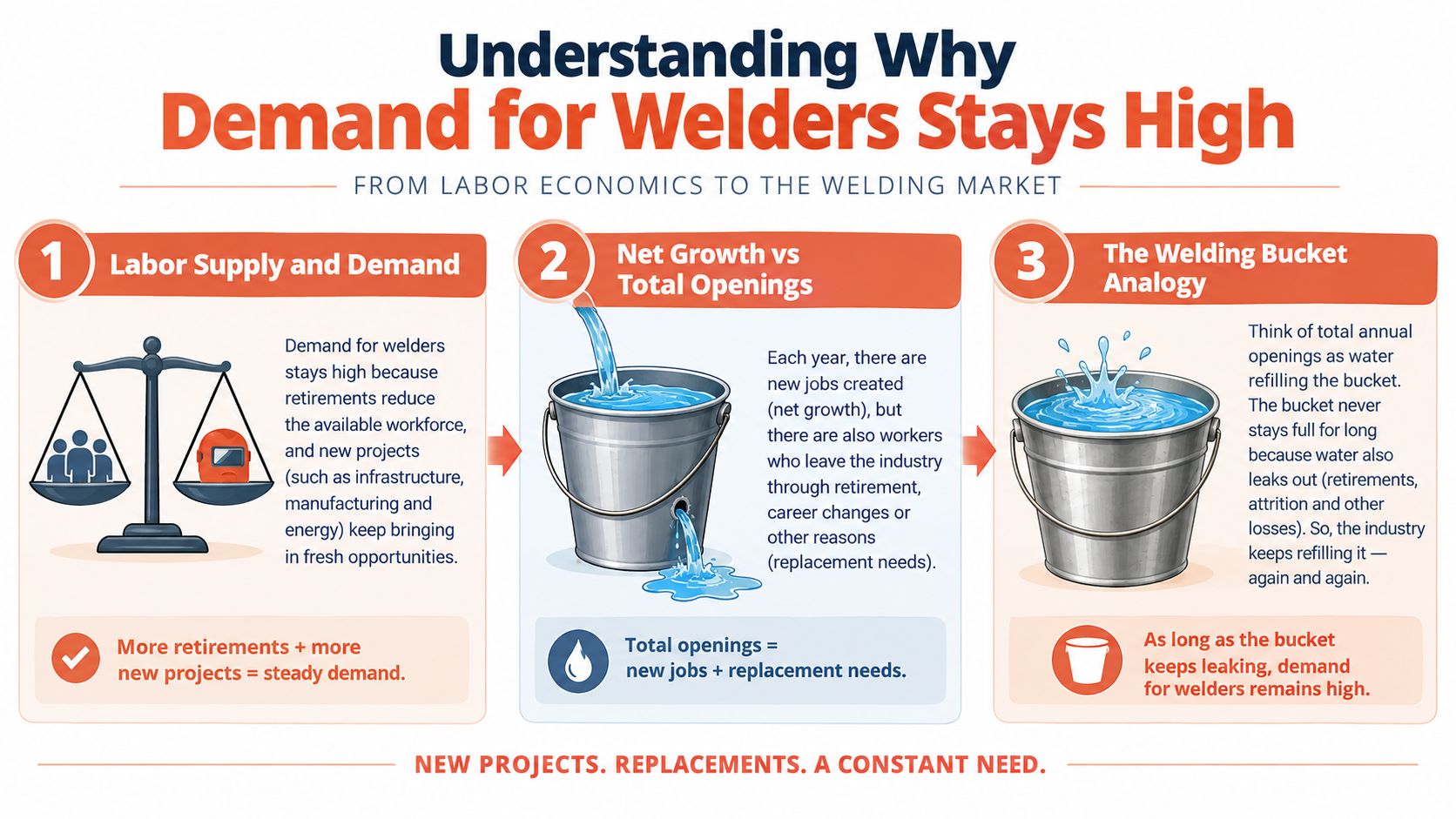
The best way to understand this demand is to separate net job growth from total openings. Growth tells you how much the occupation expands overall. Openings tell you how many seats employers need to fill because people retire, move, or leave for different work. Those are not the same thing, and welding demand is driven heavily by the second one.
Practical rule: If a trade has modest headline growth but a long stream of openings, hiring stays tense even when the economy feels flat.
Welding sits where production, maintenance, and infrastructure meet. A factory needs welders to build parts. A contractor needs welders to keep steel moving on site. A repair crew needs welders when equipment fails and downtime gets expensive. That mix creates a steady floor under hiring, because work keeps showing up in different settings.
Growth is not the whole story
The BLS projection makes the pattern clear. The occupation is expected to grow from 437,700 workers in 2025 to 448,100 in 2035 — about 2%, or 10,300 jobs over ten years — while the same projection shows 40,300 annual openings (BLS). In plain terms, the market is not waiting for dramatic expansion. It is constantly refilling seats.
The American Welding Society's workforce data points the same way. It projects 320,500 new welding professionals will be needed in the US by 2029, against an estimated 771,000 US welding professionals as of 2025, with more than 157,000 approaching retirement age (AWS welding workforce data). Note that AWS counts a broader set of welding-related roles than the BLS occupation code does, so the two totals aren't directly comparable — but both describe a workforce where exits, not expansion, drive most of the hiring.
What posting data adds
Government projections are useful, but they move slowly — the BLS wage figures above carry a May 2025 reference date, and Job Bank's Canadian wages reference 2023–2024. Posting data shows how employers are behaving right now.
The Tradesppl Hiring Index is computed monthly from postings on our own board, which is why we can put a current number against the trend. Welding was the third-largest trade by posting volume in August 2026 (237 postings) and sits at 551 live listings today. Turnover, not expansion, is doing the heavier lifting — which is why openings stay high even when the occupation doesn't look like a rapid-growth story on paper.
Where Welding Jobs Are Concentrated and Why
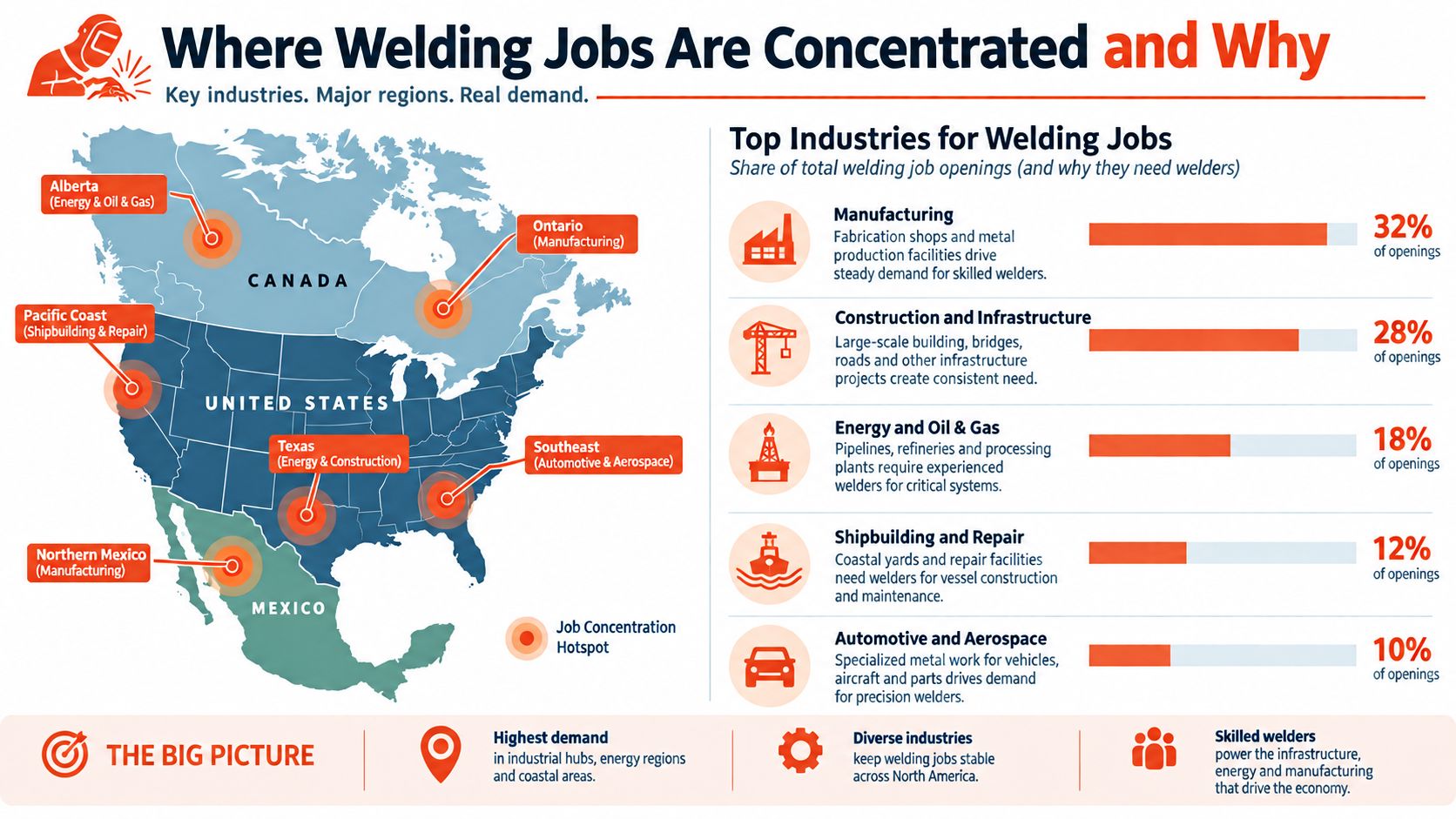
Welding jobs cluster where steel is built, repaired, moved, or kept in service: manufacturing zones, construction corridors, energy infrastructure, marine yards, and transport-heavy regions. Employers hire where physical assets are being assembled and where downtime is costly.
Our live board makes that concentration concrete. Of the 551 welding listings open on 14 September 2026, four regions hold the clear majority:
| Region | Country | Live welding listings |
|---|---|---|
| Texas | US | 232 |
| Alberta | CA | 149 |
| Ohio | US | 59 |
| Saskatchewan | CA | 46 |
| Illinois | US | 7 |
| Manitoba | CA | 7 |
Texas and Alberta alone account for roughly 69% of every open welding role on the board. Both are energy- and fabrication-heavy economies, and both show up at the top of the all-trades regional table in the August 2026 Hiring Index as well (Alberta 301 postings, Texas 204).
Industry mix shapes local demand
A region with dense fabrication shops keeps posting shop-based roles because production rarely stops. A region with bridges, roads, and commercial builds needs structural welders who can move from site to site. Coastal yards, refinery areas, and heavy-industry corridors add another layer. That is why a local market can feel tight even when the national picture looks stable.
It also explains the long tail in the table above. Once you get past the top four regions, counts fall into single digits — so a welder outside Texas, Alberta, Ohio, or Saskatchewan is competing in a much thinner local market, and widening the search radius matters more.
How to read a geographic search
Ask whether openings are widespread or localized. Widespread demand shows up across several regions and job types — shop, field, and maintenance roles. Localized demand shows up when one area has a sharp cluster because of a single project, plant outage, or seasonal construction cycle. The difference changes how fast you should move.
Use location filters, trade filters, and region pages to sort the noise from the openings. Geographic taxonomy pages narrow the search to a city, state, or province instead of scrolling through unrelated roles.
If the same trade appears in several regions, the problem is usually supply, not just one employer's posting.
What Employers Are Paying and How Pay Transparency Helps
Welding pay makes more sense once you break it into parts. Employers price for process, experience, location, and how hard the role is to fill.
In the August 2026 Hiring Index, US welding postings that advertised pay showed a median of $53,333 a year (about $25.64 an hour) across a sample of 73 postings, with a middle range of $45,500 to $65,520. That lands within about 1% of the BLS median annual wage of $53,750 ($25.84 an hour, May 2025) — independent confirmation that what employers advertise and what welders actually earn are tracking closely in this trade.
In Canada, Job Bank reports welders (NOC 72106) earning a median of C$30.00 an hour, ranging from C$22.00 to C$47.00 (Job Bank wage report, updated November 2025, 2023–2024 reference period). We are not publishing our own Canadian welder median this month: only a handful of the 207 live Canadian welding listings disclose pay, which is below the sample threshold our methodology requires. That gap is itself the finding — see below.
The shortage isn't showing up in wages yet
Here's the part the shortage headlines tend to skip. Welding is the third-most-posted trade on our board but the lowest-paid of the major trades we track. From the same August 2026 edition, median advertised annual pay for US postings:
| Trade | Median advertised pay (US) | Postings |
|---|---|---|
| Plumbers | $78,000 | 189 |
| Pipefitters | $74,492 | 95 |
| HVAC technicians | $73,134 | 242 |
| Electricians | $68,640 | 439 |
| Welders | $53,333 | 237 |
A genuine, sustained supply crunch usually shows up in pay. High posting volume alongside the lowest median of the five biggest trades suggests something more specific than a simple shortage: employers need a lot of welders, but a large share of the demand sits in production and fabrication roles priced near the occupation's wage floor, not in the specialized pipe and code work that commands a premium.
For welders, that's an argument for specialization rather than volume of applications. For employers competing for experienced hands, it's a warning that a posting priced at the median is priced at the middle of a market where the scarce people are at the top.
Pay disclosure is the other half of the picture, and the gap between countries is stark. In August 2026, 42.1% of US postings disclosed pay, against just 8.6% in Canada — see our pay transparency report for the full regional breakdown. That's why a Canadian welder often can't compare two offers without applying to both.
How to read an offer
A posted wage only tells part of the story. One employer may be pricing for a first-stage apprentice. Another may be pricing for a journeyperson who can work independently. Some offers bake in nights, overtime, field travel, or specialized work, so the number can look similar while the job is very different.
| Pay Factor | What to Look For | Why It Matters |
|---|---|---|
| Experience level | Apprentice, journeyperson, or senior-level language | Sets the baseline for expected productivity |
| Process specialization | MIG, TIG, stick, flux-cored, or pipe work in the posting | More specialized work often narrows the candidate pool |
| Schedule | Day shift, nights, overtime, or travel | Less convenient schedules usually need stronger offers |
| Certification wording | Required, preferred, or not mentioned | Helps you tell must-have items from nice-to-haves |
| Location and site type | Shop, field, plant, or remote jobsite | Working conditions affect how candidates compare offers |
For employers, pay transparency reduces back-and-forth and helps candidates decide faster whether the role fits their level. For jobseekers, clear pay is a filter: if the wage and the work don't line up, they can move on. That speed matters because most welding openings are replacement-driven — when one worker leaves, the employer needs a fit quickly.
Certifications and Skills Employers Actually Require
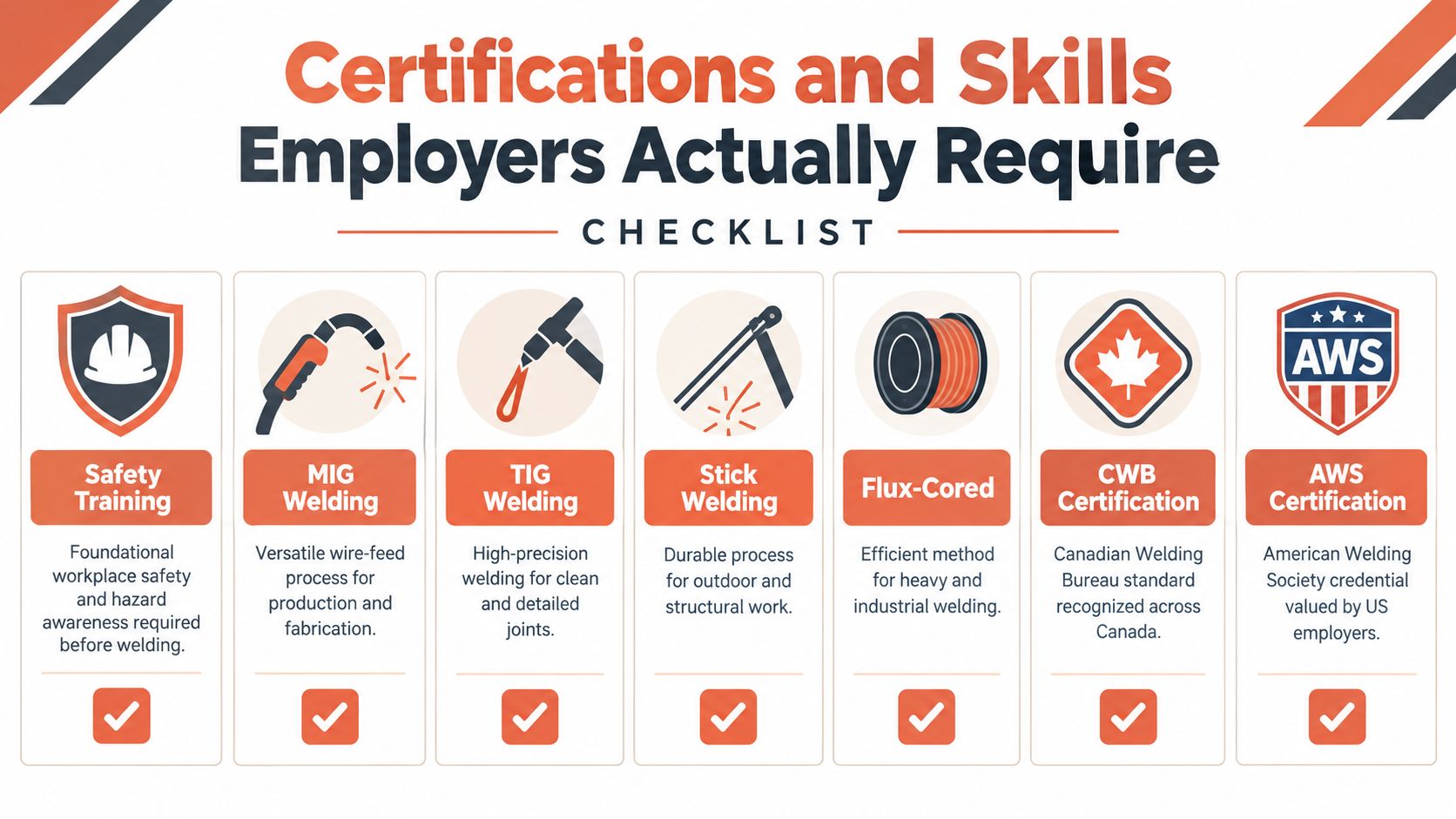
Welding credentials work best as a ladder, not a pile of acronyms. The first rung is safety and basic process training. Then come the common methods employers ask for, then the industry-specific or code-driven certifications that separate a general applicant from someone ready for specialized work.
MIG, TIG, stick, and flux-cored come up often because they map to different work settings. MIG is common in production and fabrication. TIG appears when the job needs cleaner, more precise joints. Stick still shows up in outdoor and structural work. Flux-cored matters in heavier industrial settings where speed and deposition count.
CWB leads the credentials employers name
When we count the certifications named in welding postings on our own board, one credential leads clearly. Across the 127 live welding listings that name any certification, the most-requested are:
| Certification | Live welding listings naming it |
|---|---|
| CWB (Canadian Welding Bureau) | 67 |
| Red Seal | 40 |
| Rigging & signalling | 33 |
| Fall protection | 20 |
| CSTS | 17 |
| Confined space | 13 |
The August 2026 edition showed the same ordering (CWB 35, Red Seal 23, rigging and signalling 18). Two things are worth drawing out.
First, CWB is the single most-named welding credential in our data, which reflects how much of the board's welding demand sits in Alberta and Saskatchewan. AWS certification is widely valued by US employers, but it is named far less often in postings than CWB is — US employers more often specify the process and the code than a named certifying body.
Second, most welding postings name no certification at all: 127 of 551 live listings, or roughly 23%. Read that as an opening rather than a reason to skip credentials. Where a certification is named it functions as a gate, and the postings that name one are disproportionately the better-paid specialized roles.
Practical rule: If a posting says a certification is "required," treat it as a gate. If it says "preferred," treat it as a signal that your application still has room to compete.
You can check what a given jurisdiction expects with our certification tracker and code lookup tools, and see the full credential breakdown in the Hiring Index certifications report.
Build the skill path in order
New entrants usually move fastest when they build from safety to one or two core processes, then add the credential that matches the kind of work they want. Someone aiming for shop fabrication needs a different mix than someone aiming for structural or pipe work.
There's a catch worth knowing about before you start. Of the welding postings in August 2026 that specified an experience level at all, only 7 of 60 were apprentice-level. Employers are overwhelmingly advertising for people who can already work — which means formal apprenticeship placements are scarcer than the raw demand numbers suggest, and time-to-proficiency is the thing employers are actually paying for.
Track the exact wording employers use in postings: the process names, the certification names, and the experience level together. Then compare them with your own training history.
The important part is not collecting every credential. It's matching the right credential to the work.
How Jobseekers and Employers Can Move Faster
Speed matters in welding hiring because good fits don't stay open long. The fastest matches happen when both sides remove friction at the same time.
For welders
Start with a complete profile. Put your licences, certifications, work history, and preferred processes in one place so you're not rewriting the same details on every application. Then use filters for location, pay, and job type so you don't waste time on roles that don't fit your level or travel tolerance.
- Complete your profile fully. Add work history and credentials so employers can read your background quickly.
- Show certifications clearly. Put the most relevant ones near the top, not buried in a paragraph — and if you hold CWB, lead with it.
- Use search filters with intent. Narrow by trade, location, and pay before you apply.
- Widen the radius if you're outside the top four regions. Texas, Alberta, Ohio, and Saskatchewan hold most of the open roles.
- Turn on alerts. New postings move fast in replacement-driven markets.
For employers
Write postings the way experienced welders read them. State the pay range, the process, the shift, and the certification expectations up front. Use a standardized candidate view so your team screens on the same criteria instead of sorting by guesswork. Then reach out quickly to the short list.
If you're hiring in Canada, disclosing pay is close to a free differentiator right now: at an 8.6% disclosure rate, a posting with a real range stands out against roughly eleven out of twelve competitors that don't have one.
Practical rule: The more obvious the requirements, the fewer mismatched applications you'll read.
| Situation | Jobseeker Next Step | Employer Next Step |
|---|---|---|
| Need to move today | Apply only to clear matches with current credentials | Publish a transparent posting with must-have requirements |
| Have a solid base but need a better fit | Refine filters by region and process | Screen for process-specific experience first |
| Are still building experience | Focus on entry roles that match training | Separate required skills from preferred ones |
For readers comparing platforms, our best job boards guide covers how trade-focused search behaves differently from general job sites.
Next Steps for Welders and Hiring Teams
The clearest lesson in this market is that welder demand is a long-term structural reality, not a temporary surge. It comes from the steady churn of people retiring, switching occupations, and leaving vacancies behind — 40,300 US openings a year against an occupation growing by roughly 1,000.
But the pay data complicates the simple shortage story. Welding is the third-most-posted trade on our board and the lowest-paid of the major trades. The leverage for a welder is therefore in specialization, certification, and location, not in applying more widely. The scarce, well-paid work is code-driven pipe and structural work in the regions where it concentrates.
For employers, the same three levers apply from the other side: post in the right region, disclose pay clearly (especially in Canada), and ask for the credentials that actually separate capable candidates from casual applicants.
Want to check your own number rather than a national median? Compare live welding postings and advertised pay by region on Tradesppl, or read the full August 2026 Hiring Index.
How we compiled this data
First-party figures in this article come from two sources. Monthly figures (posting counts by trade, advertised-pay medians, pay-disclosure rates, experience mix) are from the August 2026 Tradesppl Hiring Index, computed from the 1,397 trade postings created on our board in August 2026; pay statistics are published only where at least eight postings in a cell disclose pay, and hourly figures annualize at 2,080 hours. Live figures (551 welding listings, regional counts, certification counts) are a snapshot of open listings on 14 September 2026 and will change as postings turn over.
External figures are attributed inline: US employment projections and wages from the BLS Occupational Outlook Handbook (May 2025 wage reference), US workforce estimates from AWS, and Canadian wages from Job Bank (NOC 72106, 2023–2024 reference period). Our methodology is documented at tradesppl.com/hiring-index/methodology. Hiring Index figures are free to cite with attribution.