
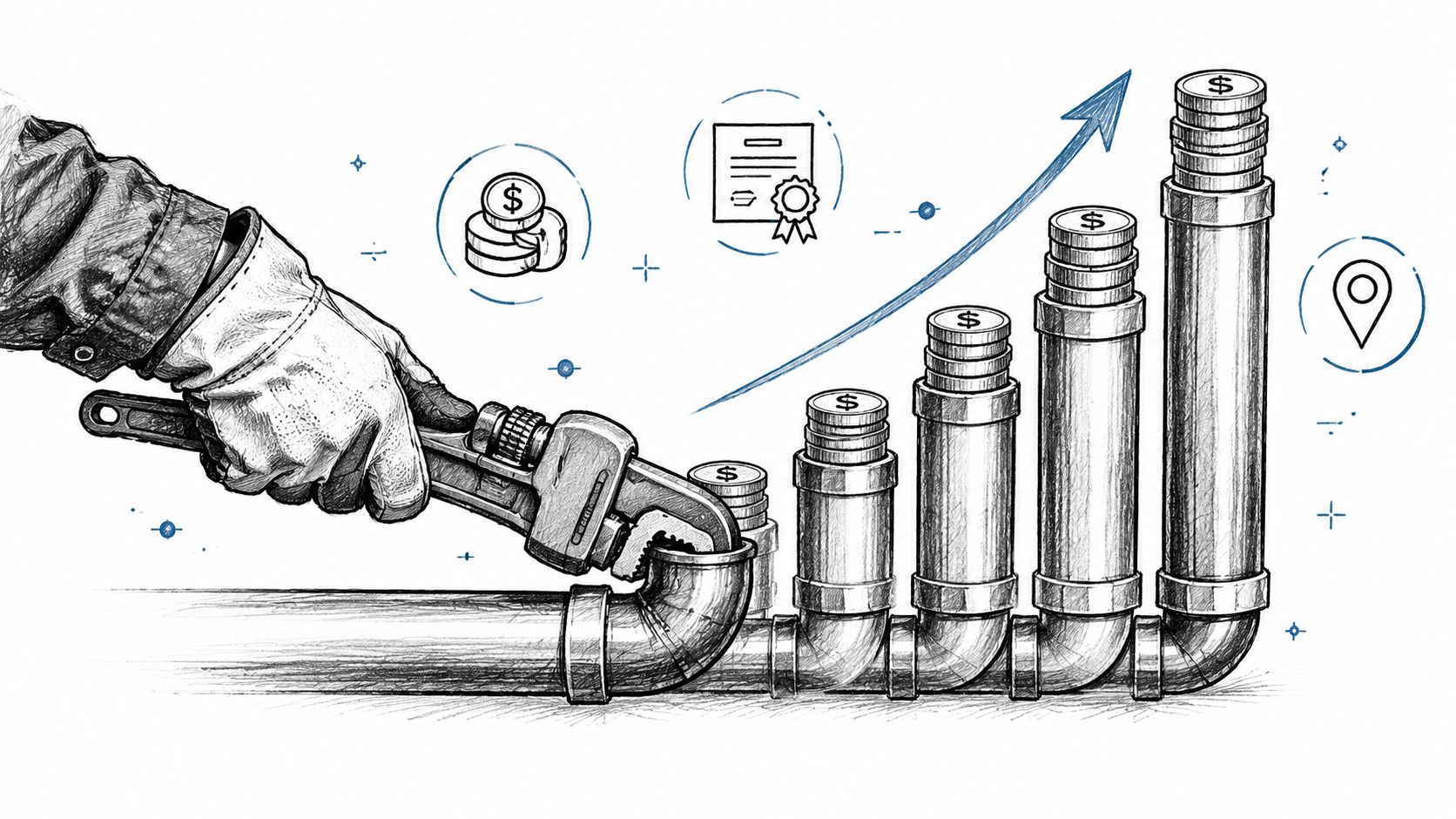
Pipefitters in the United States had a median annual wage of $63,800 in May 2025, or $30.67 an hour, and the occupation's pay spread ran from about $44,150 at the 10th percentile to $108,420 at the 90th. That's the cleanest answer to the question, but it isn't the full picture, because real postings in 2026 don't cluster neatly around a single midpoint, they split by level, region, and job type.

The BLS wage table for plumbers, pipefitters, and steamfitters shows a broad earnings ladder, not a tight band, and that matters more than the headline median when you're comparing apprentices, journeypersons, and master-level roles. The same BLS data also show the median rose from $56,330 in May 2020 to $63,800 in May 2025, a gain of $7,470 over five years, and the 10th percentile climbed from $33,460 to about $44,150 over that period, which tells you entry pay also moved up BLS pipefitter wage data.
The practical question is whether that median matches what employers are posting right now. It mostly doesn't. In our August 2026 Hiring Index, computed from the job postings published on our own board, US pipefitter postings that disclosed pay ran a median of $74,492 a year ($35.81 an hour) — roughly $10,700 above the BLS all-worker median. Posting volume, union scale, and open-shop negotiation don't show up the same way in a national wage snapshot.
A better way to read the number is as a midpoint for the occupation, not as a promise. The median is useful, but the distribution is the story, and that's why the rest of this guide separates apprentice, journeyperson, and master pay instead of treating pipefitter salary as one flat figure.
Table of Contents
- What Pipefitters Earn Right Now
- How the Pipefitter Pay Ladder Works
- What Drives Pipefitter Pay Higher or Lower
- Sample Pipefitter Pay by Level and Region
- Comparing Posted Wages to Government Wage Data
- How to Move Up the Pipefitter Pay Band
- Key Takeaways and Where to Check Current Figures
What Pipefitters Earn Right Now
The clearest headline is the BLS median for plumbers, pipefitters, and steamfitters, which places pipefitter salary at $63,800 a year, or $30.67 an hour. The spread is wider than the midpoint suggests. The lowest 10% earned about $44,150, while the top 10% earned more than $108,420, a gap that points to real differences between general field work, industrial shutdowns, and supervisory roles BLS pipefitter wage data.
Read the median as a midpoint, not a ceiling
The survey groups many assignments under one occupation code, so one title can cover very different pay settings. A shop helper, a shutdown pipefitter working nights, and a foreman in heavy industrial work can all appear in the same wage table, even though employers price them differently.
A practical read starts with role and pay structure, then checks whether the offer is tied to overtime, union scale, or a project premium. That is where advertised pay often diverges from the survey median.
A straight-line projection from the earlier BLS trend points to a higher midpoint, but that is an analytical estimate, not a published government figure. The useful conclusion is narrower. The occupation has been moving up enough that a fixed annual number can understate current pay pressure, especially in postings that compete for experienced workers.
The comparison that matters is between the published median and live listings. BLS gives the occupation-wide benchmark. Employer postings show what firms are willing to write down for apprentice, journeyperson, and master-level roles right now — the live pay box on this page shows the current advertised figures from our own board.
How the Pipefitter Pay Ladder Works
Pipefitting sits inside the broader plumber, pipefitter, and steamfitter occupation, but the pay ladder changes with job authority, not just with trade experience. Apprentices work under supervision and earn while they train. Journeypersons are expected to handle full productive work on their own. Master-level workers, where that credential exists, often carry permitting authority, code responsibility, and crew leadership.
Apprentice, journeyperson, and master mean different jobs
A registered apprentice is still in a structured program that combines classroom instruction with on-the-job hours. That registration matters because it ties wages to progression steps, not just to time on site. Journeyperson status marks the point where the worker can perform the trade independently at full productive value. Master-level credentials usually add supervisory scope, permit signing authority, or direct accountability for code compliance.
A wage ladder only works if the role ladder is clear first.
That is why the comparison should start with scale, then move to dollar amounts. Apprentices usually earn a share of journeyperson pay while they build hours and credentials. Master-level work sits higher because the role includes more than installation, it includes planning, oversight, and the risk that comes with being the person responsible when something fails.
| Pipefitter Pay Ladder by Career Level (U.S. and Canada) | |||
|---|---|---|---|
| Level | % of Journeyperson Scale | U.S. Annual Range (USD) | Canadian Annual Range (CAD) |
| Apprentice | Lower share of full scale | Lower than full rate, paid training phase | Lower than full rate, paid training phase |
| Journeyperson | 100% baseline | Full productive wage | Full productive wage |
| Master | Above journeyperson scale | Higher than journeyperson, often supervisory | Higher than journeyperson, often supervisory |
In the U.S., apprenticeship wage steps are often set through union locals, contractor groups, or registered apprenticeship standards, while open-shop employers can adjust offers more freely. The BLS describes the occupation as spanning training, full trade work, and advanced responsibility (BLS, 2025). Canada's Job Bank wage grid shows the same ladder in practice: steamfitters, pipefitters and sprinkler system installers (NOC 72301) run from a low of $27.00 an hour to a national median of $43.89 and a high of $55.59 Job Bank wage report. The demand ladder is visible in live postings too — in our August 2026 Hiring Index, of the pipefitter postings on our board that named an experience level, about one in four was an explicitly apprentice-level role. The useful takeaway is simple. The title matters less than where the worker sits on the ladder.
What Drives Pipefitter Pay Higher or Lower
Four variables move pipefitter salary more than almost anything else, geography, certifications, union status, and shift type. The same trade can look modest in one market and strong in another, even when the title stays the same.
Location does the heaviest lifting
Geography creates the widest spread because industrial demand is uneven. High-cost or heavy-industrial markets usually pay more than lower-demand regions, while states with weaker industrial concentration tend to sit below the national center. A pipefitter offer in a refinery corridor belongs in a different pay bucket than a light commercial HVAC project.
Credentials raise the floor
Certifications change the wage conversation because they reduce training time for the employer. Welding credentials, NCCER, medical-gas endorsements, and backflow-related skills can all move a worker into a narrower, more valuable applicant pool. What employers actually ask for backs this up: in the August 2026 Hiring Index, rigging and signalling, fall protection, and site-safety credentials (CSTS, H2S Alive, confined space) were the qualifications most often named in pipefitter postings on our board — a distinctly industrial mix that reflects where the hiring pressure is. The effect is not identical everywhere, but the direction is consistent, more documented skill usually means stronger bargaining power.
Practical rule: the wage premium from a credential shows up fastest when the certification matches the employer's real bottleneck, not when it just looks good on a resume.
Union status and shift premium aren't the same thing
Union work tends to publish scale more openly, and benefits often make the total package stronger than the posted hourly rate alone suggests. Open-shop roles can still pay well, but the compensation structure is usually more negotiable and less predictable. Night work, weekend work, and shutdown schedules can also lift the offer because employers need coverage when plants cannot stop.
| Factors That Move Pipefitter Pay Above or Below the Median | |||
|---|---|---|---|
| Factor | Directional Impact vs. Median | Typical Range | Representative Example |
| Geography | Higher in industrial or high-cost markets, lower in weaker markets | Market-dependent | Major refinery, shipyard, or metro project |
| Certifications | Higher with specialized credentials | Credential-dependent | Welding or medical-gas skill set |
| Union Status | Higher total compensation where scale and benefits are priced in | Contract-dependent | Signatory local scale |
| Shift Type | Higher on nights, weekends, shutdowns | Assignment-dependent | Plant turnaround work |
For a nearby trade comparison, the wage logic is similar to what shows up in the HVAC technician salary guide. The structure is different, but the pay drivers follow the same underlying logic, location and specialization still dominate.
Sample Pipefitter Pay by Level and Region
A realistic pipefitter salary table works as a market map, not a promise. The same title can land in a low market, a median market, or a high market depending on industrial density, cost of living, and whether prevailing wage rules apply.
Low, median, and high markets don't pay the same way
Low markets usually reflect weaker industrial demand, fewer shutdown projects, and limited prevailing-wage coverage. Median markets sit in the middle on those pressures. High markets tend to show up where industrial density is heavy, cost of living is higher, or public and union work sets a firmer wage floor.
| Sample Hourly Pay Ranges by Level and Market Tier | Low Market ($/hr) | Median Market ($/hr) | High Market ($/hr) |
|---|---|---|---|
| Apprentice | 24 to 30 | 28 to 34 | 32 to 40 |
| Journeyperson | 32 to 38 | 36 to 44 | 50 to 62 |
| Master | 58 to 75 | 58 to 75 | 80 to 110 |
These are directional bands. They are useful because they show where pay starts to separate by level. In a low market, a journeyperson can still earn a solid wage, but a high market can push the same title into a different bracket when the work is industrial, union, or tied to prevailing wage. In Canada, the Job Bank national grid for the occupation ($27.00 low, $43.89 median, $55.59 high per hour, in CAD) maps onto the same tiers — the currencies aren't interchangeable, but the shape of the ladder is the same Job Bank wage report.
Posted hourly pay often understates total compensation. Overtime, per diem, and wage classification on public projects can push annual earnings well above the base rate.
That is why the offer has to be read with the work conditions attached. A lower hourly number with steady overtime can out-earn a higher base rate with fewer hours, especially on shutdowns or travel-heavy jobs. The best comparison is the posted rate plus the schedule, the contract setting, and the region's wage floor.
Comparing Posted Wages to Government Wage Data
Live postings and survey medians often differ because they measure different things. Our Hiring Index shows what employers are advertising now, while BLS and Job Bank tables summarize broader wage patterns. The useful comparison is the gap between posted pay and survey medians — and for pipefitters right now, that gap is real. In the August 2026 Hiring Index we tracked 95 pipefitter postings; the US postings that disclosed pay ran a median of $74,492 a year, with the middle half of offers between $65,411 and $93,337 — though across 20 disclosing postings, so treat it as directional rather than definitive.
Posted pay tends to cluster by level
Current postings usually separate by title before they separate by region. Apprentice listings tend to start lower, but some active offers still reach into the lower end of the broader market range. Journeyperson postings on industrial and prevailing-wage work sit closer to the middle of the occupation. Master and foreman roles break away more often when the work is tied to heavy industry or urgent project needs.
| Advertised Pay vs. Government Wage Data | Median | Spread | Coverage |
|---|---|---|---|
| Tradesppl Hiring Index (Aug 2026, US postings) | $74,492/yr ($35.81/hr) | $65,411 to $93,337 (middle half of disclosed offers) | First-party advertised pay |
| BLS May 2025 | $63,800/yr ($30.67/hr) | $44,150 to $108,420 (10th to 90th percentile) | Survey wage benchmark |
| Job Bank Canada (NOC 72301) | $43.89 CAD/hr | $27.00 to $55.59 CAD/hr | Canadian wage benchmark |
An advertised median sitting roughly $10,700 above the BLS all-worker median is not a contradiction. Postings can bundle shift differentials, per diem, and project urgency into the advertised rate, while survey medians smooth those factors out — and open positions skew toward experienced roles in markets where employers are actively competing for people. A wage-benchmark calculator can help translate one posting into a livable comparison; the Tradesppl wage benchmark calculator provides that function.
Canada's Job Bank wage tables show the same pattern from a different angle. The occupation sits on a wage ladder, and regional variation is real Job Bank wage report. The currencies should not be treated as interchangeable, but the structure is consistent. Skilled pipefitting pays above helper-level work, and the spread widens when region and project type change.
How to Move Up the Pipefitter Pay Band
Changing job conditions, overtime, per diem, shift type, or project classification can raise annual earnings faster than waiting for a title change, because those levers affect the current pay cycle.
Start with pay levers that act this year
- Overtime and per diem. These are the quickest levers because they can lift annual pay in the current role. Shutdown work, travel jobs, and plant assignments tend to show the effect first.
- Prevailing-wage projects. Public and covered projects can set a higher floor because pay is tied to the project structure, not only the worker.
- Specialized certifications. Welding credentials, NCCER, and trade-specific endorsements strengthen an application when the employer has a narrow need.
- Union apprenticeship completion. Finishing the program and moving into journeyperson status changes how employers price the worker, from trainee rates to full-production rates.
- Relocation to high-demand regions. Heavy industrial and coastal markets can shift the offer range quickly, especially where shutdown labor is scarce.

The sequence matters because some moves pay off immediately while others take months or years. Overtime and per diem can change one job. A credential or apprenticeship completion changes how employers read the next offer.
For workers tracking the next step, our certification and licensing tracker lets you look up the license tiers, apprenticeship hours, and exams for your trade in your own state or province. Use it to match credentials to real openings, not to chase a title that looks better on paper.
Key Takeaways and Where to Check Current Figures
The core number for pipefitter salary in the United States is still the BLS May 2025 median of $63,800, with a $44,150 to $108,420 spread that makes clear how wide the occupation can run BLS pipefitter wage data. In live 2026 postings the market runs hotter: the August 2026 Hiring Index put the advertised US median at $74,492, while master and foreman ads in industrial markets skew higher because they bundle more responsibility into the role.
The four pay drivers that matter most are location, certifications, union status, and shift type. Apprenticeship level matters too, but as the ladder beneath the offer, not as a standalone answer. That's why a true pay comparison needs all three layers, survey median, posted wage, and the worker's place in the ladder.
Methodologically, the cleanest way to compare figures is to treat government data as the benchmark and advertised pay as the live market signal. BLS and Job Bank show the broader wage structure, while our Hiring Index reflects what employers are putting in front of candidates in the current market. If you're checking current numbers, use the live postings first, then verify the benchmark against government tables before you negotiate.
Check your own number
- Pipefitter jobs — current pipefitting openings on the board, with pay shown where employers disclose it
- Pay calculator — turn an hourly rate into take-home pay with overtime
- Hiring Index — this month's postings, advertised pay, and hiring regions across every trade
Tradesppl tracks posted pay, certification demand, and live trade openings across the U.S. and Canada, so it's a useful place to compare what pipefitter jobs are offering today with what survey data says they should pay. If you want a current read on pipefitter listings, wage benchmarks, and the credentials employers are asking for, browse the live pipefitter listings and compare the posting details against the market data before you apply.